This article was written with AI assistance and reviewed for accuracy where possible; details about unreleased or rumored products may change.
Whether you are a digital nomad hopping between continents or a weekend warrior heading out for a quick getaway, the way you pack your technology can make or break your trip. Nothing ruins a smooth airport experience quite like fumbling through a tangled mess of charging cables, dead batteries, or the dreaded realization that your international adapter is sitting on your kitchen counter. Building a travel tech kit isn’t just about hauling gadgets; it’s about creating a streamlined, efficient system that keeps you powered and productive no matter where you land.
At MINIDROP, we believe that the best travel tech is the kind you don’t have to think about. It should be intuitive, compact, and reliable. In this guide, we’ll walk you through the essential components of a foolproof travel tech kit, from power management to cable organization, and how to select gear that fits your specific travel style.
The Foundation: Choosing the Right Organizer
Before you even look at your gadgets, you need a home for them. A loose collection of chargers in the bottom of your backpack is a recipe for broken connectors and lost items. Investing in a high-quality tech organizer is the most important step in building your kit. Look for a clamshell-style case with elastic loops and mesh pockets. This allows you to see everything at a glance and keeps items from shifting during transit.
If you prefer a minimalist approach, consider a slim organizer that fits inside your laptop bag. If you are a heavy traveler with multiple cameras and devices, a larger, padded pouch might be necessary. The goal is to create a ‘grab-and-go’ solution that keeps your essentials secure. Remember, the best tech kit is one that stays packed and ready, so you aren’t scrambling to hunt down your wall plug every time you head to the airport.
Power Management: The Lifeblood of Your Kit
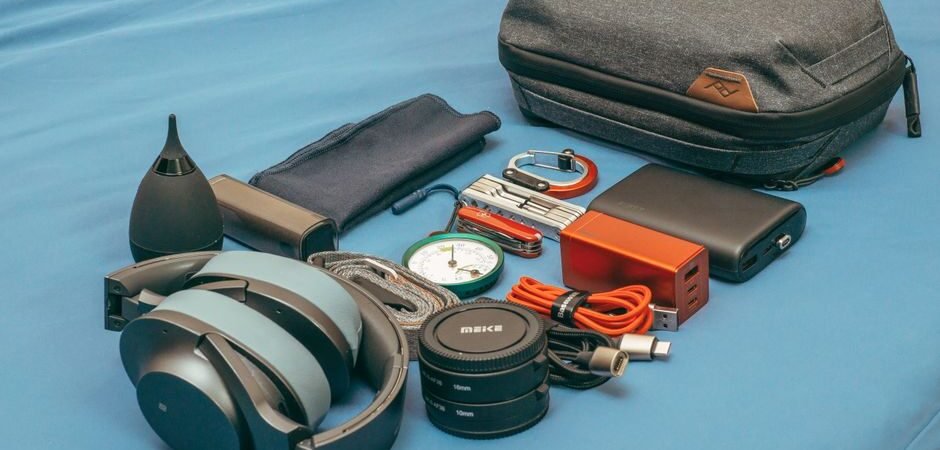
Power is the most critical aspect of any tech kit. When you are moving through terminals or navigating new cities, finding a reliable wall outlet isn’t always an option. Your core power strategy should revolve around three components: a high-capacity power bank, a universal wall charger, and a reliable set of cables.
When choosing a power bank, look for one that supports fast charging and has enough capacity to charge your primary devices at least once or twice. Many travelers now opt for power banks with built-in AC prongs, which allow the bank to double as a wall charger. For your wall adapter, prioritize GaN (Gallium Nitride) chargers. They are significantly smaller and lighter than traditional silicon chargers while offering more power, allowing you to charge your laptop, phone, and tablet simultaneously from a single outlet.
Cable Discipline: Taming the Tangled Web
Cables are the bane of every traveler’s existence. The best way to manage them is to adopt the ‘one cable, many devices’ philosophy wherever possible. Invest in high-quality, braided USB-C cables that support both high-speed data transfer and fast power delivery. Braided cables are much more durable and resistant to the sharp bends that often cause fraying.
Use cable ties or small velcro wraps to keep your cables neatly coiled. Never store a cable tightly wound, as this puts unnecessary strain on the internal wiring. If you find yourself carrying too many different cable types, look for modular cables or multi-tip adapters, though be careful to choose high-quality versions that won’t compromise your device’s battery health. If you are interested in upgrading your aesthetic while you travel, you might find that keeping your gear color-coded helps in quickly identifying your different charging setups.
Audio and Connectivity: The Quiet Essentials
Travel can be loud, chaotic, and unpredictable. Whether you are trying to focus on work in a bustling cafe or attempting to get some sleep on a red-eye flight, high-quality audio gear is non-negotiable. Noise-canceling headphones have become a staple for frequent flyers, as they drastically reduce the fatigue caused by engine drone and ambient noise.
In addition to headphones, consider a small, durable Bluetooth speaker if you enjoy listening to music in your hotel room. For connectivity, always keep a small travel router or a reliable mobile hotspot if your destination’s Wi-Fi is questionable. Many travelers also pack a small, lightweight set of adapters for legacy ports, just in case they need to plug into older monitors or hotel sound systems. Remember to pack a pair of high-quality wired earbuds as a backup; they never run out of battery, and they are essential for in-flight entertainment systems that don’t support Bluetooth.
Organizing for Security and Protection
When traveling with expensive electronics, security is paramount. Always keep your tech kit in your carry-on luggage; never check your primary electronics. If you must leave your tech in a hotel room, invest in a portable, cable-style travel lock to secure your bag to a fixed object.
Data security is another layer of the ‘tech kit’ concept. Consider using a hardware-encrypted USB drive for sensitive files, and always carry a physical backup of your most important documents. If you are frequently using public Wi-Fi, ensure you have a reputable VPN service configured on all your devices before you leave home. This small software addition provides a massive boost to your peace of mind when working on the road.
Adapting to Your Specific Travel Needs
Not every tech kit needs to be the same. If you are a photographer, your kit will naturally lean toward high-capacity SD card cases, portable hard drives, and extra camera batteries. If you are a student or a remote worker, you might prioritize a portable laptop stand or a compact mechanical keyboard. The key is to assess your daily workflow and identify the gaps.
If you find yourself constantly needing to shift between professional and casual settings, think about how your tech gear complements your attire. For instance, when you are out exploring, you might want a slim sling bag to keep your phone and portable charger handy, rather than carrying your full laptop backpack. Mixing and matching your carrying solutions—like keeping a primary kit in your main bag and a smaller ‘go-bag’ for daily excursions—is a pro move that keeps you agile.
Future-Proofing and Upkeep
Technology changes rapidly, and your travel kit should be a living system. Every few months, take stock of what you actually used and what ended up being dead weight. If you carried a specific adapter for two years and never used it, it’s time to take it out. If you found yourself constantly needing a specific length of cable, make that swap.
Keep an eye on emerging trends in battery technology and connectivity. While there are always rumors of new charging standards or sleeker, more powerful devices on the horizon—such as rumored next-generation foldable tablets or reportedly improved long-range wireless charging—stick to reliable, proven technology for mission-critical travel gear. Buying the latest ‘bleeding edge’ tech often means dealing with beta-level bugs, which is the last thing you want when you are thousands of miles from home. Focus on durability and universal standards like USB-C, and your kit will serve you well for years to come.
Ultimately, a well-built travel tech kit is about freedom. It’s the freedom to work from a beach in Bali, the freedom to capture memories in a mountain range, and the freedom to stay connected with loved ones no matter the time zone. Take the time to curate your setup, keep it organized, and you’ll find that your travel experience becomes significantly smoother and more enjoyable. Happy travels!
Beyond the Hardware: The Digital Workflow
While your physical gear provides the backbone of your travel setup, your digital organization is equally vital to maintaining a stress-free environment. Before heading to the airport, take a moment to synchronize your offline assets. Ensure that your essential travel documents, maps, and offline entertainment are cached locally on your devices rather than relying on cloud access. Many travelers benefit from utilizing a dedicated “Travel” folder on their laptop or tablet that contains saved boarding passes, hotel reservations, and emergency contact information in PDF format. This simple habit protects you from the sudden panic of a lost signal or a failed authentication attempt when you are standing in a crowded lobby.
The Art of Maintenance and Routine
The longevity of your travel kit depends heavily on how you treat it once you arrive at your destination. Dust, humidity, and varying voltage standards in different regions can take a toll on sensitive equipment. Make it a habit to wipe down your connectors with a dry microfiber cloth, as salt air or desert dust can easily find its way into charging ports and interfere with connections. If you are traveling to a region with unstable power grids, consider carrying a small, inexpensive surge protector or a voltage-stabilized power strip. While it adds a bit of weight to your bag, the peace of mind that comes with knowing your expensive laptop or camera is protected from a sudden power surge in an older building is well worth the extra ounces. Treat your kit with the same care you would your passport, and it will remain a reliable companion for years of adventures.
The Importance of Modular Weight Distribution
As you refine your tech kit, you will likely find that weight distribution becomes as important as device selection. Carrying all your charging equipment, heavy hard drives, and power banks in one single pouch can create a bulky, awkward “brick” that is difficult to pack into a carry-on or under-seat bag. Instead, consider adopting a modular approach. Keep your high-frequency items—such as your phone charger, a small portable battery, and your noise-canceling earbuds—in a smaller, secondary “everyday carry” pouch that you can easily move from your main luggage to your personal bag for quick access. This prevents the need to dig through your entire bag during transit and keeps your essential power sources within arm’s reach during long flights or train rides.
Managing Battery Health During Transit
Frequent travelers often overlook the impact that extreme temperatures and constant, shallow charging cycles can have on lithium-ion batteries. When traveling, try to avoid leaving your tech kit inside a hot car or in direct sunlight, as heat is the primary enemy of battery longevity. Furthermore, if you are planning to store your gear for an extended period between trips, aim to keep your power banks and laptop batteries at roughly 50% charge rather than leaving them completely depleted or topped off at 100%. If your devices support “smart charging” or “optimized battery charging” features, ensure these are enabled in your settings; these tools can intelligently manage the charging flow during overnight hotel stays, preventing the battery from sitting at 100% capacity for hours on end, which can degrade its overall lifespan over time.
Streamlining Through Simplified Peripherals
As you become more intentional about your tech load, you might find that shedding unnecessary peripherals is just as important as selecting the right ones. Many travelers fall into the trap of carrying legacy adapters or specialized cables for gear they rarely use. Evaluate your kit with a “critical use” lens: if a specific accessory hasn’t been used in three consecutive trips, it likely doesn’t deserve the precious space in your organizer. Consider replacing bulky, single-purpose accessories with versatile alternatives, such as a compact USB-C hub that integrates multiple ports, an SD card reader, and an HDMI output into a single, slim form factor. By reducing your hardware footprint, you not only lighten your load but also decrease the time spent troubleshooting connection issues when you arrive at your destination.